U.S.-Middle East Relations (fall 2024)
Course Requirements:
- Final exam: 45%
- NSC-style group presentation: 30%
- Participation: 15%
- Quizzes: 10%
Contact Information:
- email (kcjohnson9@gmail.com)
- cell (207-329-8456);
- office hours: via zoom: M, 11.30-1.00, T 12.15-2.00, and Friday 11.30-12.30
- zoom link: https://us02web.zoom.us/j/82246646081
- Meeting ID: 822 4664 6081
Course Structure:
This course is an all-remote, onlne mix class.. Each week features a synchronous & asynchronous session.
The asynch session consists of three or four lecture snippets–posted on the course youtube page & Blackboard, & also emailed to everyone. Lecture snippets should be viewed consecutively but you don’t need to watch them all at once–I try to do each snippet as a discrete item. Snippets will go out on Sunday night with a quiz on their contents. Quiz plus a question/comment about the material should be back to me by Thursday night. I’ll do up a Q&A video responding to some of the questions for sending out on Friday.
The synchronous session will feature a discussion about the week’s readings (documents and journal articles). The discussion groups will range from 7-9 people & meet each week at the same time. I’ll send out a signup sheet with possible times after our introductory meeting. Whichever time you sign up for will be your meeting time throughout the term (though, obviously, if you have a conflict one week and need to attend another section, you can just let me know). Your discussion group will also be your NSC presentation group.
Course Schedule:
August 28: Introduction
w/o September 2: [asynchronous only, lecture snippets] [two quizzes this week]
Monday: The Ottoman Decline and Middle East International Relations
Wednesday: World War I & Middle East International Relations
w/o September 9: [discussion sections start this week]
asynchronous lecture snippets: The Interwar Era
synchronous discussion section:
- Erez Manela, “The Wilsonian Moment and the Rise of Anticolonial Nationalism: The Case of Egypt,” Diplomacy & Statecraft, pp. 99-122.
- Erez Manela, “Goodwill and Bad: Rethinking US-Egyptian Relations in the Interwar Years,” Middle Eastern Studies, pp. 71-88.
- Amikam Nachmani, “’It is a Matter of Getting the Mixture Right’: Britain’s Post-War Relations with America in the Middle East,” Journal of Contemporary History, pp. 117-140.
- State Dept. on US oil production in former Ottoman Empire, 1923: https://history.state.gov/historicaldocuments/frus1923v02/d876
- League of Nations Charter (excerpts, email)
w/o Sept. 16:
asynchronous lecture snippets: World War II
synchronous discussion section:
- Arthur L. Funk, “Negotiating the ‘Deal with Darlan’,” Journal of Contemporary History, pp. 81-117.
- Klaus-Michael Malmann and Martin Cuppers, “’Elimination of the Jewish National Home in Palestine’: The Einsatzkommando of the Panzer Army Africa 1942,” Yad Vashem Studies, pp. 111-141.
- Breckenridge Long memoir (excerpts, email)
- US reaction to Soviet/British occupation of Iran:
- https://history.state.gov/historicaldocuments/frus1941v03/d385
w/o Sept. 23:
asynchronous lecture snippets: The Ciold War Arrives
synchronous discussion section:
- Toru Onozawa, “Formation of American Regional Policy for the Middle East, 1950–1952: The Middle East Command Concept and Its Legacy,” Diplomatic History, pp. 117-148.
- Melvyn P. Leffler, “Strategy, Diplomacy, and the Cold War: The United States, Turkey, and NATO, 1945-1952,” The Journal of American History, pp. 807-825.
- Soviet Politburo plan to support separatist activities in Iranian Azerbaijan, 1945 (email)
- High-ranking US officials debate recognizing Israel, 1948: https://history.state.gov/historicaldocuments/frus1948v05p2/d252
- Truman Doctrine address, 12 March 1947 (excerpts, email)
w/o Sept. 30: [one class this week per college schedule–asynchronous only]
lecture snippets: Eisenhower and the Cold War
- Irwin Wall, “The United States, Algeria, and the Fall of the Fourth French Republic,” Diplomatic History, Vol. 18, pp. 489-510.
- Anthony Gorst and W. Scott Lucas, “The Other Collusion: Operation Straggle and Anglo-American Intervention in Syria, 1955-1956,” Intelligence and National Security, pp. 576-595.
- CIA contemporary analysis, “What We Learned” from 1953 covert operation in Iran”
- Soviet contemporary analysis–Egyptian/Soviet relations
- Eisenhower Doctrine (excerpts, email)
- Kennedy 1957 Algeria speech (excerpts, email)
w/o Oct. 7:
asynchronous lecture snippets: Realigning Middle Eastern International Relations
synchronous discussion section::
- Zaki Shalom, “Kennedy, Ben-Gurion and the Dimona Project, 1962–1963,” Israel Studies, pp. 3-33.
- James Goode, “Reforming Iran during the Kennedy Years,” Diplomatic History, pp. 13-29.
- Zach Levey, “The United States’ Skyhawk Sale to Israel, 1966: Strategic Exigencies of an Arms Deal,” Diplomatic History, Vol. 28, pp. 255-276.
- JFK and Israel’s nuclear program: https://nsarchive2.gwu.edu/israel/documents/first/15-01.htm
- Rusk & Israeli nuclear program (email)
w/o Oct. 14:
asynchronous lecture snippets: Diplomacy of the Six-Day War
synchronous discussion section::
- Galia Golan, “The Soviet Union and the Outbreak of the June 1967 Six-Day War,” Journal of Cold War Studies, Vol. 8, pp. 3-19.
- Zaki Shalom, “Lyndon Johnson’s Meeting with Abba Eban, 26 May 1967: [Introduction and Protocol],” Israel Studies, pp. 221-236.
- senior officials in State Dept., who want more flexibility on Israel’s part regarding arms sales.
- Robert Komer, helping to conduct the negotiations with Israel, skeptical about wisdom of pressing Israel.
- Resolution 242
- Soviet response to events
w/o Oct. 21:
asynchronous lecture snippets: Regional Instability
synchronous discussion section::
- Noam Kochavi, “Insights Abandoned, Flexibility Lost: Kissinger, Soviet Jewish Emigration, and the Demise of Détente,” Diplomatic History, pp. 503-530.
- Fiona B. Adamson, “Democratization and the Domestic Sources of Foreign Policy: Turkey in the 1974 Cyprus Crisis,” Political Science Quarterly, pp. 277-303.
- Nigel Ashton, “Pulling the Strings: King Hussein’s Role during the Crisis of 1970 in Jordan,” International History Review, pp. 94-118..
w/o Oct. 28:
asynchronous lecture snippets: The Regional Effects of the Iranian Revolution
synchronous discussion section:::
- Mitchell Bard, “Interest Groups, the President, and Foreign Policy: How Reagan Snatched Victory from the Jaws of Defeat On AWACS,” Presidential Studies Quarterly, pp. 583-600.
- Catherine Scott, “Bound for Glory: The Hostage Crisis as Captivity Narrative in Iran,” International Studies Quarterly, pp. 177-88.
- “444 Days in the Dark: An Oral History of the Iran Hostage Crisis,” GQ.
- Alan J. Kuperman, “The Stinger Missile and U.S. Intervention in Afghanistan,” Political Science Quarterly, pp. 219-263.
w/o Nov. 4:
asynchronous lecture snippets: Gulf War and Beyond
synchronous discussion section::
- H. W. Brands, “George Bush and the Gulf War of 1991,” Presidential Studies Quarterly, pp. 113-131.
- Lawrence Freedman & Efraim Karsh, “How Kuwait Was Won: Strategy in the Gulf War,” International Security, pp. 5-41.
- Gulf War chronology
- A. Marshall, Phased Withdrawal, Conflict Resolution and State Reconstruction
w/o Nov. 11
asynchronous lecture snippets: Beyond the Cold War
synchronous discussion section:
- Mark Schafer and Stephen G. Walker, “Democratic Leaders and the Democratic Peace: The Operational Codes of Tony Blair and Bill Clinton,” International Studies Quarterly, pp. 561-583.
- Benny Morris and Ehud Barak, “Camp David: An Exchange,” New York Review of Books, 13 June 2001.
- Hussein Agha and Robert Malley, “Camp David: Tragedy of Errors,” New York Review of Books, 9 Aug. 2001.
- Dennis Ross, “Camp David: An Exchange,” New York Review of Books, 20 Sept. 2001
- Kosovo Timeline
w/o Nov. 18:
asynchronous lecture snippets: The W. Bush Years
synchronous discussion section:
- Final Report of the National Commission on Terrorist Attacks Upon the United States Executive summary
- Kevin Woods, James Lacey, and Williamson Murray, “Saddam’s Delusions: The View from the Inside,” Foreign Affairs, May/June 2006.
- Meltem Müftüler-Bac, “Turkey and the United States: The Impact of the War in Iraq,” International Journal, pp. 61-81.
- Ronald Bruce St John, “’Libya Is Not Iraq’: Preemptive Strikes, WMD and Diplomacy,” Middle East Journal, pp. 386-402.
w/o Nov. 25: [one class only per college schedule–asynchronous only]
lecture snippets: The Obama Years
w/o Dec. 2:
lecture snippets: Trump & Biden
asumchronous disicussion section:
reading TBA
w/o Dec. 9: presentations
due Dec. 19: Final Examination
Learning objectives for this course include: (1) ability to read and interpret key historical sources; (2) ability to determine how important themes in U.S.-Middle Eastern relations change over time; (3) ability to present key historical arguments orally. Item (1) will occur throughout the course; item (2) will occur in the midterm and final examination; item (3) will occur in the oral presentation.
This course follows all applicable college policies; see more in: https://www.brooklyn.cuny.edu/web/off_registrar/2021-2022_Undergraduate_Bulletin.pdf
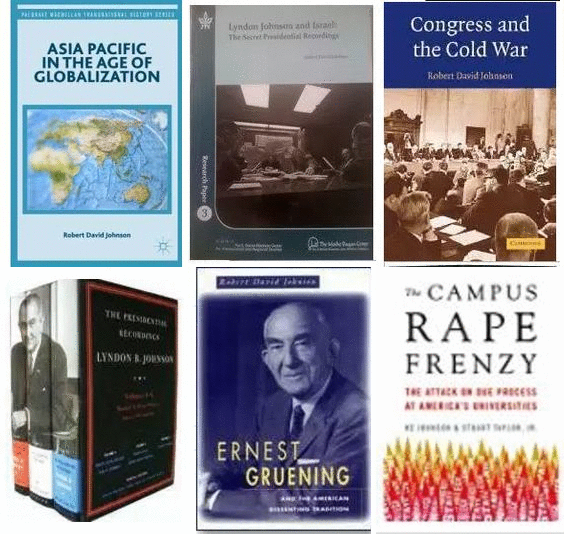
 KC Johnson