Senior Thesis Class (fall 2025)
Contact Information:
- email (kcjohnson9@gmail.com)
- cell (207-329-8456)
Course Requirements:
- Attendance and participation (25%): Attendance is mandatory for this course. Participation is also essential to this seminar. Your informed response to assigned readings, class discussion, and your colleagues’ ideas is vital to the success of everyone in the room. The autobiographical statement is part of the participation assignment. Unexcused absences will be penalized by one grade shift (A-minus to B-plus, for example) in your final semester grade.
- Research log (5%): The research log should record how you are researching (e.g. which search terms in which database), what you are finding (notes from these resources), and your reflections or inspirations (or problems) as you go along. Your weekly log should be emailed to me each Sunday night in Sept.; after that, we’ll have group checkins that will fulfill this function.
- Annotated bibliography (10%): This assignment will allow you to determine the key issues, debates, and approaches relevant to your chosen topic, and to position your ideas into broader scholarly debates.
- Presentation (20%): At the end of the semester, you will be asked to make a formal (5-7 minute) presentation on your research topic.
- Written assignments, including thesis chapter (40%): The chapter will be the culmination of this semester’s work, and is due at end of term. This assignment includes the draft, the completed introduction, and two position papers. All papers should be submitted to me via email. All assignments also should be submitted to your advisor.
Groups: The class will be broken down into groups (based on mutual interest as much as possible) on Oct. 1.
Due dates:
- September 4: Autobiographical statement
- September 4: Advisor choice due
- Sept. 25: Preliminary Bibliography
- October 10-17: Position paper I
- October 16: Thesis proposal
- before October 23: NCUR proposal
- Oct. 23: Annotated bibliography
- Oct. 30: Annotated bibliography, II
- November 6: Position paper II
- November 20: Draft intro (tentative)
- December 24: Draft chapter
Course Schedule:
August 26: Introduction
August 26-Sept. 2: Individual meetings with instructor
Sign up for time slot via form.
Week 2: Approaches to Research Problems
Autobiographical Statement due: 2 pages. Your statement should focus on how your personal background and intellectual interests have led to your research area. (You don’t need specficity about your topic here.) Please speculate on ways to connect with your readers and indicate what your key questions are at this point.
Submit the paper to me (via e-mail) and to your advisor. The essay also will be briefly presented to class. You should have confirmed your advisor by this point.
week 3: Institutional Review Board issues
Review IRB requirements and CUNY Policy on Academic Integrity before class
Contemporary research ethics controversies:
Chat GPT case:
- “The Chat GPT Lawyer Explains Himself“
- lawyer affidavit from case describing his “research” strategies
- court order (pp. 3-21 only)
Stanford president research misconduct case:
- student journalist explains how he helped break the case (with article)
- investigation: executive summary (pp. 7-11)
- op-ed on ramifications for scientific research
Harvard Business School scandal:
week 4: Research Foundations
Library Session (with Prof. Philogene): We’ll meet in Library Room 122 for this class
Week 5: Preliminary Bibliography
Bring one source or article to class; be prepared to summarize to the class.
[Group assignments made.]
week 6: In class workshop: position paper
Position Paper due: 2-3 pages. Indicate your research question and then choose 2-3 relevant sources, provide tentative bibliographical data for each, and engage with the sources in light of your research questions. Submit the paper to me (via e-mail).
week 7: In-class workshop: thesis proposal–group 1
Draft of proposal due: 2-3 pages. Indicate your working claim and outline the main reasons that will support it. Discuss the evidence you will use to support your conclusions, and their significance. Submit the draft to me (via e-mail).
Complete & submit proposal for NCUR
week 8: In-class workshop: annotated bibliography–group 2
Draft of Annotated Bibliography due: 5 sources minimum. In addition to designating the source’s thesis, annotations should respond to the source’s key arguments in relation to your topic. Submit the draft to me (via e-mail).
Thesis Proposal due, along with indication of approval from your advisor.
week 9: In-class workshop: annotated bibliography–group 3
Annotated Bibliography due: 8 sources minimum. In addition to designating the source’s thesis, annotations should respond to the source’s key arguments in relation to your topic. Be prepared to discuss your findings to the class.
week 10: In-class workshop: Position Paper II–group 4
Longer position paper due: 5-7 pages. Outline three of your major claims. Submit the draft to me (via e-mail),
week 11: In-class workshop: Introduction–group 5
Submit draft of introduction: research question, key scholarly debates, framework of chapters. Submit the draft to me (via e-mail).
weeks 12-14: Individual presentations
December 24 @ 11.59pm: Chapter and draft introduction (20pp. or so) due, via e-mail
Accessibility
In order to receive disability-related academic accommodations you must first be registered with the Center for Student Disability Services. Students who have a documented disability or suspect they may have a disability are invited to set up an appointment with the Director of the Center for Student Disability Services at 718-951-5538. The Center is located at 138 Roosevelt Hall.
Course Objectives
Upon successful completion of this year-long course, you will have:
- facility in reading, summarizing, and evaluating a variety of texts that provide material for your research project
- the capacity to pose a research question and to imagine and implement methods address this question, including finding credible library and electronic sources
- competence in crafting arguments using supportive evidence and logic
- proficiency in the use of quotations, paraphrases, and appropriate documentation for scholarly publication
- capacity to present your ideas effectively orally
- a talent for engaging in intellectual conversation about wide variety of topics and academic disciplines
- skills to give useful and respectful feedback to colleagues on their thinking, writing, and oral presentations
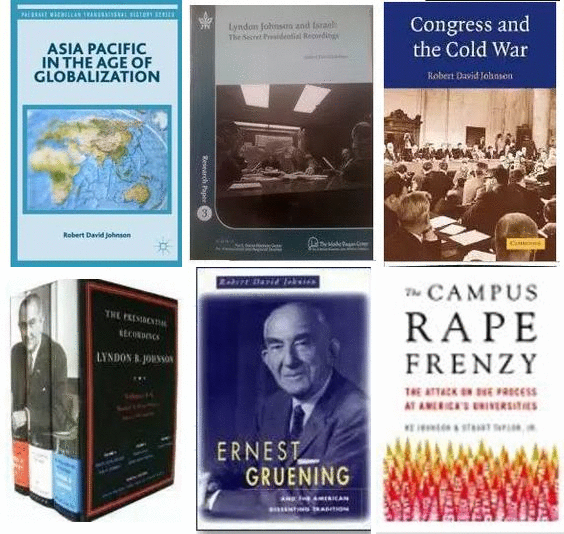
 KC Johnson